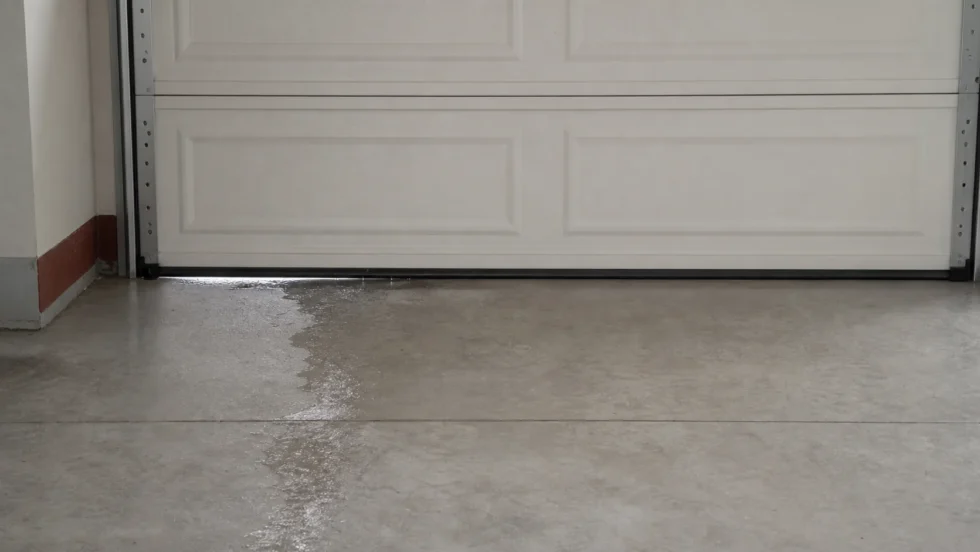
Cold garage, wet door
Is the door sweating, leaking or getting wet from snowmelt?
Trace the water first. Then use an overnight temperature log and a dew-point check to choose a fix that fits your garage.
This guide uses manufacturer instructions and building-science sources. We have not tested dehumidifiers, measured drying times or performed a garage-door insulation comparison.
Start with the water pattern
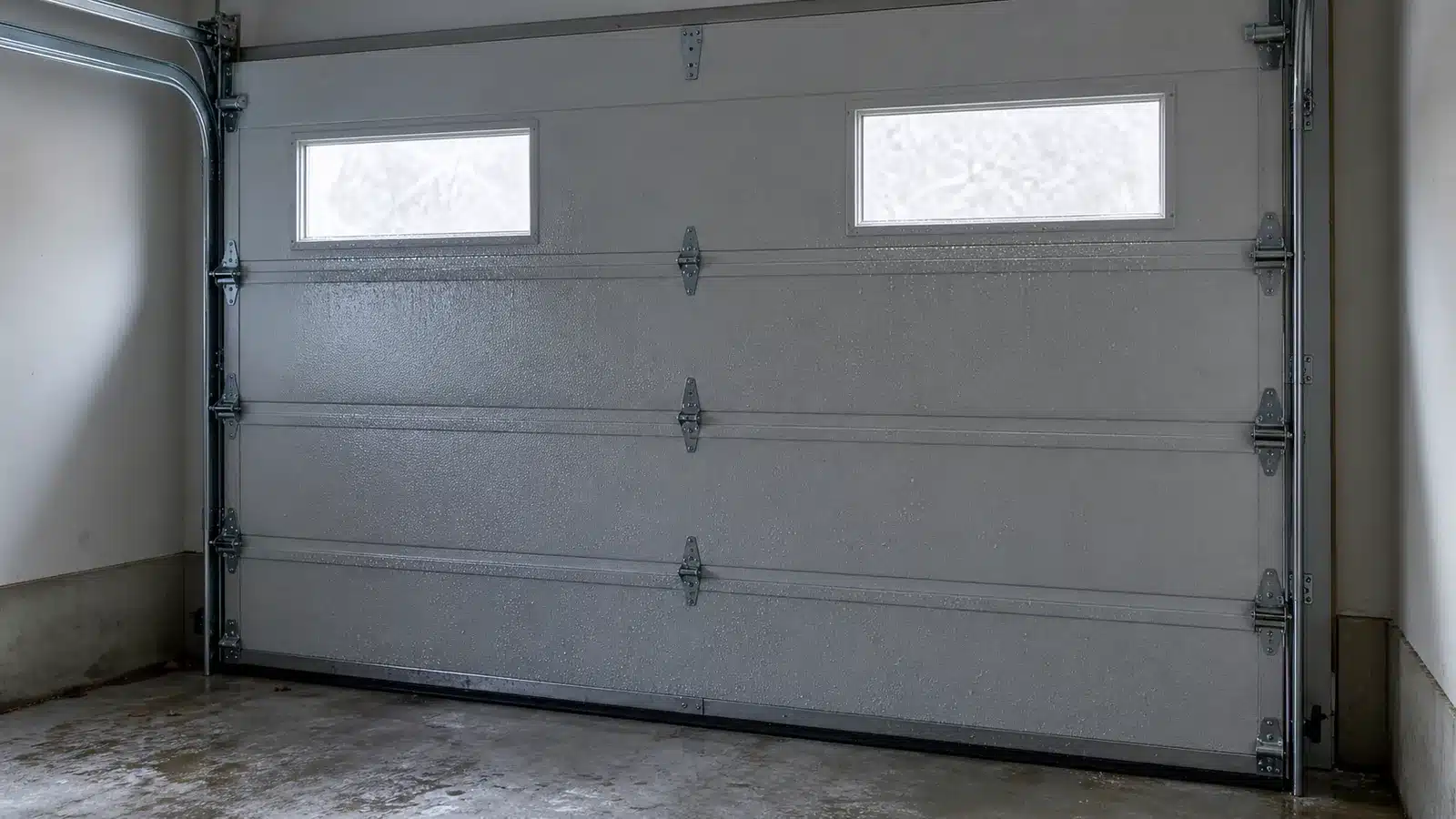
Inside-surface condensation usually appears as beads, a wet sheen or frost on cold metal or glazing. Water may be heaviest around windows and panel edges. A snowy vehicle can supply moisture after the door closes; it can also leave an unrelated puddle on the floor.
| What you see | Check next | Where to start |
|---|---|---|
| Beads across the garage-side door face | Garage dew point and the temperature of the wet surface during the event | Moisture-source control and the measurements below |
| Water tracks from an edge during rain | Top, side and bottom seals, glazing perimeter and exterior drainage | Water-entry diagnosis |
| Puddles under a wet or snowy vehicle | Wheel wells, vehicle runoff and where the slab directs meltwater | Remove snow outdoors and collect or remove meltwater |
| Fog trapped between window panes | Whether it wipes off either exposed face | A door technician's glazing assessment |
Dry a small area and watch whether droplets form again under the same conditions. Photograph the pattern before opening the door. If a wet surface appears warmer than the calculated dew point, recheck the readings and timing before assuming condensation; mixed causes are possible.
DASMA's condensation guidance distinguishes surface condensation from fogging that may indicate a double-pane seal failure. Insulated glazing can still condense in a humid garage.
Remove the moisture source before running equipment
- Snow and slush: brush off heavy accumulation outdoors. Collect and remove meltwater before it evaporates, without blocking the door or making a trip hazard.
- Leaks and wet materials: repair roof, plumbing or drainage problems; move drying laundry, wet rugs and similar loads to an appropriate location. A dehumidifier cannot repair water entry.
- Appliances: vent a clothes dryer properly outdoors. Have fuel-burning appliances and their venting assessed if there are moisture or draft problems.
Measure three things before choosing a fix
- Garage air temperature and relative humidity: place a suitable sensor away from heater outlets, wet floors, direct sun and door-edge drafts. Allow it to stabilize.
- Dew point: enter those readings into the National Weather Service calculator. Use the garage readings, not the outdoor weather app.
- Door-surface temperature: check the wet panel, its edges and glazing while the moisture is present. A surface at or below the surrounding air's dew point can collect condensation.
A contact surface probe can help with difficult materials. With an infrared thermometer, follow its instructions for emissivity and distance: Fluke explains why shiny surfaces can mislead an infrared reading. It measures a surface, not air humidity. Avoid treating a difference of a degree or two as decisive when the instruments' uncertainty is similar.
More moisture in the same air
Garage: 50°F / 60% RH
Calculated dew point: about 37°F
Door surface: 35°F
The surface is below dew point: condensation can form.
Less moisture in the same air
Garage: 50°F / 40% RH
Calculated dew point: about 27°F
Door surface: 35°F
The surface is above dew point under these conditions.
Make an overnight record you can repeat
- Before parking: photograph the dry door and note rain, snow and any water already on the floor. Wipe each accessible window face to distinguish surface moisture from fog trapped inside the glazing.
- Before bed and before opening the door next morning: record paired air-temperature/RH readings and whether the door is wet. Calculate dew point from each pair; separate daily minimum-temperature and maximum-humidity values may come from different times.
- While droplets are present: record the affected panel or window's surface temperature at the same time as the air readings. Note where the water starts, not just where it finally pools.
- Check the night's low: use the monitor's history to see whether conditions stayed within the proposed appliance's range. A warm afternoon reading is insufficient. If measurement uncertainty straddles the minimum, do not assume the unit fits.
A lower RH caused only by warming the air does not prove water was removed; compare dew point too. Keep your record for a similar cold night after changing one thing.
A useful first purchase: a temperature and humidity monitor
If you already have a suitable monitor, use it. A log helps you decide whether equipment fits the garage before spending more on moisture control.
As an Amazon Associate, Garage Results earns from qualifying purchases. This does not change the price you pay.
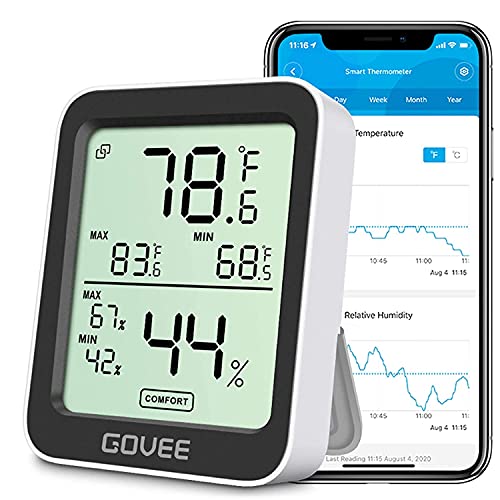
Govee H5075 Bluetooth thermometer and hygrometer
The display shows air temperature and relative humidity; the Govee Home app provides history and data export. That makes it useful for comparing conditions before and after a wet vehicle arrives.
Before ordering: this is an indoor Bluetooth model, with no Wi-Fi connection. It does not measure the door surface or remove moisture. Keep it dry, away from condensation and within its manual's operating range; do not assume it will send alerts from a detached garage while you are away.
See Govee's H5075 information for the connection and logging features. You still need a separate suitable surface thermometer for the door.
How cold is too cold for a dehumidifier?
An operating range tells you where a dehumidifier may run. It does not tell you how much water it will remove in your cold garage. Use the exact manual before running equipment, and fix rain entry or trapped window fog at its source. The models below illustrate operating limits; they are not purchase recommendations.
ENERGY STAR warns that coil frost can reduce performance below 65°F. That is a performance caution, not a universal shutoff temperature. A model's stated minimum is a separate limit, and operation near that minimum does not prove adequate water removal.
| Measured conditions | Exact-model check | What this establishes |
|---|---|---|
| Indoor garage stays within 41–95°F | Midea Cube MAD50S1QWT-A: its manual lists 41–95°F and prohibits placement below 41°F | Meets this model's temperature condition only; adequate moisture removal near its minimum is not established |
| Cooler than 41°F, but stays within 33.8–104°F | AlorAir Sentinel HD55S (White) lists this lower operating range, with gravity drainage | A lower operating minimum, with separate installation requirements; it does not establish useful drying performance near freezing |
| Falls below 33.8°F, freezes or has an unknown overnight low | These two documented ranges do not establish a suitable choice for that exposure | Neither documented range supports use in freezing exposure. Measure first, control the source and assess a properly specified system |
Example: the Midea Cube's operating limits
The Midea manual listing MAD50S1QWT-A specifies indoor residential use and a 41–95°F working range. Printed pages 13 and 16 cover positioning and temperature. Those instructions establish operating boundaries, not demonstrated drying performance in a winter garage.
Another example: the HD55S's installation limits
The HD55/HD55S manual linked by AlorAir specifies a grounded 115V/60Hz, 15-amp supply with a three-prong GFI outlet and no extension cord. Its drain needs continuous downward flow. It prints 6 feet of inlet clearance and 36 inches at discharge; do not silently read that as 6 inches. AlorAir's product page also contains conflicting refrigerant references. Resolve those details with AlorAir for the actual unit before operating it.
A lower permitted temperature is not evidence that the HD55S removes enough water at 35°F. We have no matched cold-garage capacity measurements for these units. Neither is a recommendation for below-freezing use, and a generic “desiccant” or “low temperature” label does not establish another model's limits.
Check whether the change actually helped
- On a comparable cold night, repeat the paired air readings and the same door-surface measurements. Note wet-vehicle and weather differences.
- Check that condensate reaches the bucket or drain, the hose stays clear and the appliance remains within its operating range. Follow its manual if it stops or reports an error.
- Compare dew point and the wet area, not just RH. If the door is still colder than dew point, it can still condense even after some moisture is removed. If dew point falls but water still tracks in during rain, return to the water-entry diagnosis.
When ventilation or insulation makes more sense
Outdoor air can help dry the garage when its dew point is lower than the garage air's. Comparing RH percentages alone can mislead because the temperatures differ. Any temporary air exchange also has to account for security, weather and freezing-sensitive contents. Do not leave the garage open and expect a portable dehumidifier to condition the incoming outdoor air efficiently.
Permanent ventilation in an attached garage needs a suitable design: do not route garage air into the house or casually alter the garage-to-house separation. A building or HVAC professional should assess fan placement, airflow and combustion equipment where relevant.
Insulation may warm the inside door surface under some conditions, but it does not remove moisture. Use the garage-door insulation guide for that separate buying decision. DASMA's added-weight guidance calls for explicit original-manufacturer instructions before attaching materials to the door system. Added weight can affect balance and operation; leave spring and high-tension hardware work to a trained technician.
For drafts or rain paths, identify the actual gap and compatible seal with our weather-seal guide. A tighter door can still condense if moisture remains. Fog between insulated window panes, persistent wet framing, recurring mold, electrical wetting or ice that interferes with door operation needs professional diagnosis.
Bottom Line
Confirm surface condensation, remove avoidable water and compare dew point with the door temperature. If you use a dehumidifier, follow its exact temperature, drainage and placement instructions, then check whether it lowers dew point and reduces wetting. If the garage is too cold for that model, a larger capacity badge will not solve the mismatch.
Sources and further reading
- DASMA TDS 195: garage doors and condensation
- Midea Cube manual: MAD50S1QWT-A and other listed models
- AlorAir HD55S White: specifications and linked user guide
- ENERGY STAR: operating temperature, capacity and drainage
- Fluke: infrared thermometer surface limitations
- National Weather Service: dew-point calculator
- Govee H5075: Bluetooth monitoring and logging
- DASMA TDS 176: adding weight to a door assembly
- EPA: carbon monoxide sources and prevention