Affiliate disclosure: As an Amazon Associate I earn from qualifying purchases. This does not increase the price you pay.
Choose by what the crack is doing
Rigid repair, flexible seal or professional diagnosis?
Use a rigid repair only where the concrete is sound and the defect is not expected to move. Use a flexible sealant where the manufacturer identifies movement, cracks or joints as the application. Stop shopping when the slab is displaced, actively widening, wet, soft or connected to a larger structural symptom.
Quick answer: The best concrete crack filler for a garage floor depends on the defect. Rust-Oleum 301012 is the most relevant pick here for a sound, static repair when the selected coating system accepts that repair product. Sikaflex+ Crack Flex is the flexible, textured choice for a level horizontal crack. Sashco Slab is the toolable option for an irregular crack or joint. None of them correct settlement, vertical displacement, active water or a failed slab.
A garage-floor crack is not automatically a crisis, and a narrow line is not automatically cosmetic. Width is only one clue. A crack that remains flat and unchanged presents a different job from a control joint that opens seasonally, a damp crack that bubbles a sealant, or a slab edge that has lifted into a trip point.
This guide compares products by the applications their manufacturers identify. It does not assign laboratory ratings or claim hands-on durability testing. Read the current label, Product Data Sheet and Safety Data Sheet for the exact container you buy, because surface preparation, dimensions, backing, temperature, cure and overcoating rules differ. Follow the specified ventilation, glove, eye-protection, ignition-source and disposal instructions.
Identify the garage-floor crack before buying filler
Static crack or small hole
Possible rigid repair. The edges are sound, flat, dry and not showing continuing movement. A coating-compatible epoxy patch may create a hard repair.
Crack or joint that moves
Possible flexible seal. A manufacturer-rated polyurethane or elastic acrylic can tolerate movement that would reopen a rigid surface patch.
Displaced or changing slab
Diagnose first. Filler can hide the opening, but it cannot restore support, level two slab edges or stop the cause.
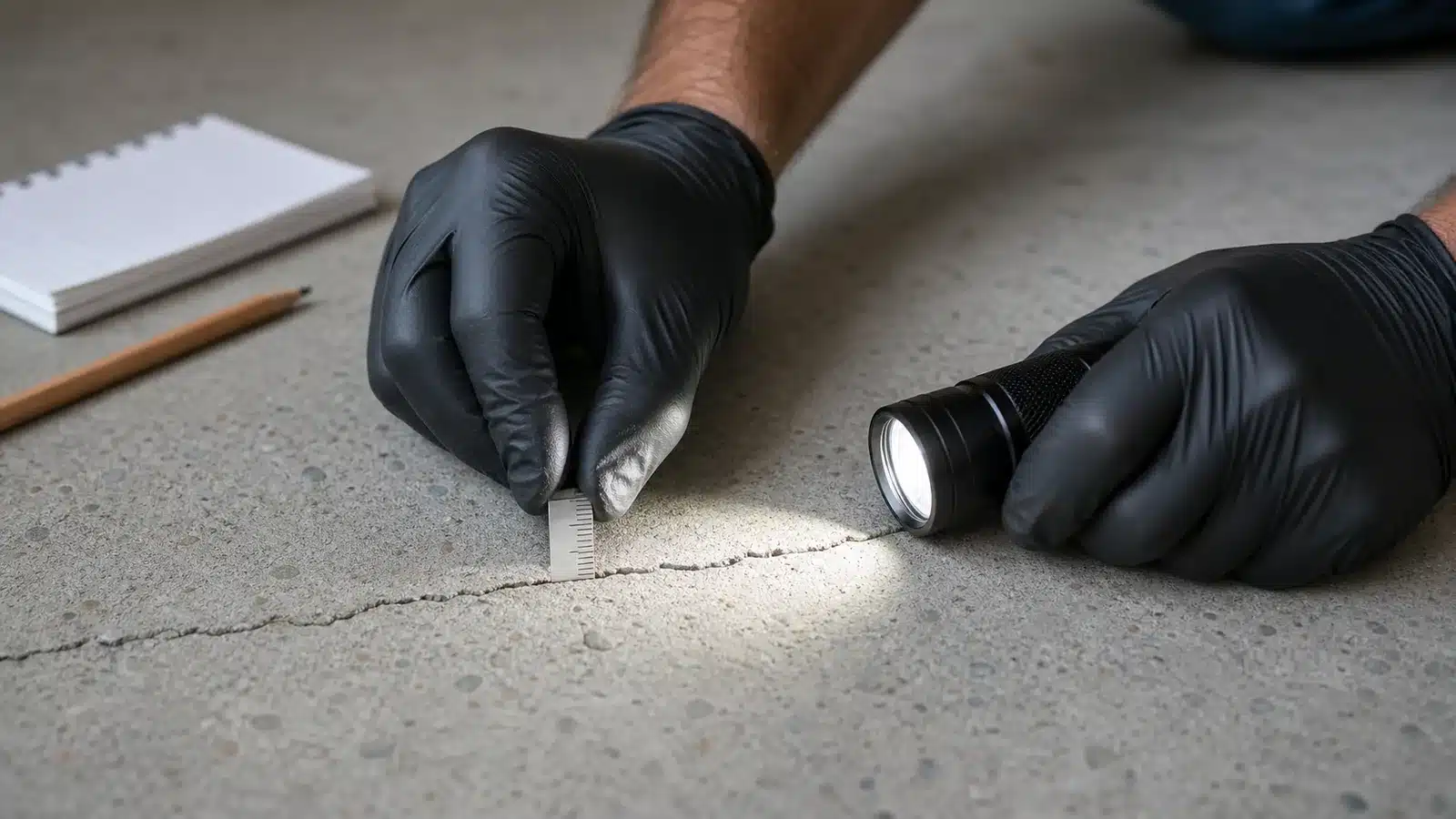
- Width: measure several points instead of describing the whole crack by its widest spot.
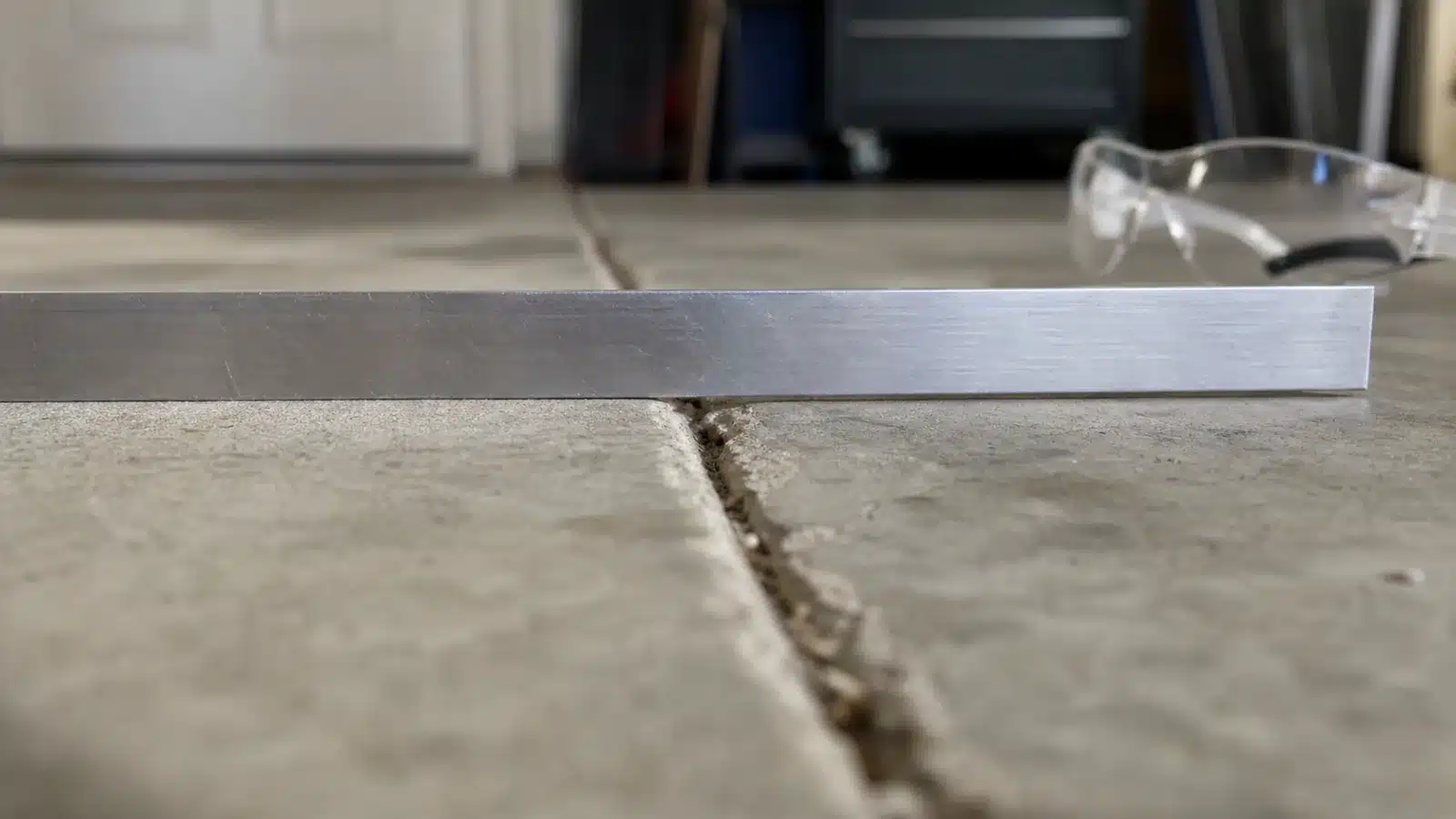
- Vertical displacement: bridge the crack with a straightedge. One side higher than the other changes the problem from filling to diagnosis.
- History: compare dated photos or marks. A crack that grows or returns through prior repairs deserves more attention.
- Moisture: look for darkening, efflorescence, wet edges, bubbling old filler or a rain-related pattern.
- Concrete condition: probe only loose surface material safely. Soft, hollow-sounding, scaling or crumbling concrete may need a broader repair.
- Contamination: oil, grease, old sealer, tire dressing, silicone and cleaner residue can prevent adhesion.
- Slope: a self-leveling product can run away on a sloped apron, ramp or drainage pitch.
- Finish plan: decide whether the repair will remain exposed or sit below an epoxy, paint or sealer system.
When concrete crack filler is the wrong first step
- One side is higher. Vertical displacement can indicate settlement, heave or loss of support. A surface filler does not level or stabilize the slab.
- The crack keeps widening. Continuing change can break a rigid repair and exceed a flexible product’s movement design.
- Water is entering. Diagnose grading, drainage, plumbing or vapor conditions. Sealant is not a substitute for fixing the source.
- Concrete is soft or spalled. A narrow bead cannot restore a weak repair zone. Remove and repair unsound material only under an appropriate system.
- Other building symptoms appear. New wall cracks, sticking doors, foundation movement or widespread slab change calls for qualified evaluation.
- The line is an intentional joint. A control, contraction or expansion joint is designed to accommodate movement. Do not rigidly bridge it just to make it disappear.
Garage-floor crack types and the material family that fits
| What you have | Material to investigate | Why | Do not assume |
|---|---|---|---|
| Very fine, flat line | Monitor first; use the exact coating or repair-system instructions if it must be opened and filled. | A filler needs enough prepared, sound surface to bond. | Smearing material over the top creates a durable repair. |
| Sound, static crack or small hole before coating | Rigid two-part epoxy repair that the selected coating system accepts. | It can cure hard and be shaped flush with the slab. | A rigid repair can tolerate a joint or continuing movement. |
| Level horizontal crack with expected movement | Flexible crack sealant rated for horizontal concrete and traffic. | Elastic material can move more than a rigid patch. | Every flexible seal can be hidden under epoxy or used on a slope. |
| Control, contraction or expansion joint | Joint sealant with the correct movement class, width/depth design and backing. | The joint is intended to open and close. | A crack filler and joint sealant are interchangeable. |
| Irregular, uneven crack or joint | Toolable, non-self-leveling flexible sealant if the manufacturer identifies the application. | It can be shaped rather than flowing to the lowest point. | A wide surface bead can replace correct depth and backing. |
| Displaced, wet, widening or widespread cracking | Professional diagnosis before a product. | The cause may be support, drainage, heave, settlement or structural movement. | A stronger or more expensive filler fixes the cause. |
Best concrete crack fillers for garage floors by use
These are best-fit selections based on current manufacturer applications and exact retailer identity, not a universal performance ranking. Confirm the exact repair dimensions, substrate, preparation, temperature, protective equipment, cure and return-to-service instructions on the container you receive.
Rust-Oleum 301012 Concrete Patch & Repair

The manufacturer identifies this two-part epoxy for concrete cracks and holes, indoors or outdoors. Rust-Oleum describes a hard, nonshrinking repair and allows painting as soon as eight hours after application under its instructions.
Best for: A sound, dry, non-moving defect that needs a hard flush repair and is compatible with the selected floor finish.
Do not use it as: A movement-joint seal, a moisture remedy or a structural fix. Confirm repair size, prep and coating compatibility.
View on Amazon →SIKA Sikaflex+ Crack Flex Sealant

The manufacturer identifies this textured, self-leveling polyurethane for horizontal cracks in concrete and cementitious slabs, including garages. It remains elastic and is designed to allow crack movement.
Best for: A clean, level, sound horizontal crack where a textured flexible seal is more appropriate than a rigid patch.
Do not use it on: A sloped surface or over a moisture-vapor condition. Overcoating requires the manufacturer’s compatibility testing.
View on Amazon →Sashco Slab 16210

The manufacturer identifies Slab for concrete repairs in garages, driveways and expansion joints. It is a textured, elastic acrylic latex sealant. Sashco says it is not self-leveling, so it can be tooled over an irregular opening.
Best for: A prepared irregular crack or joint where a flexible, textured, non-self-leveling bead is useful.
Do not use it for: Water-submersion conditions, structural repair or an unverified coating system. Use backing in deep openings as directed.
View on Amazon →Rigid epoxy repair versus flexible crack sealant
A two-part epoxy repair cures into a hard mass. That can be useful where sound concrete needs a rigid patch that can be shaped, sanded or coated as the system directs. If the opening continues to change, the new hard material may crack, debond or transfer stress to the adjacent concrete.
Polyurethane and elastic acrylic sealants are designed to remain flexible. They can be better for a crack or joint that experiences limited movement, but their softer surface, cure time, joint geometry and coating compatibility must fit the project. A flexible strip can also remain visible through a finished floor or behave differently than a rigid epoxy coating.
- Choose rigid when: the manufacturer supports a sound, non-moving repair and the complete coating system accepts it.
- Choose flexible when: the manufacturer identifies the exact horizontal crack or joint and its movement, traffic and environmental conditions.
- Choose neither yet when: the concrete is displaced, actively changing, wet, unsound or part of a broader building problem.
Control joints and expansion joints need joint thinking
A saw-cut control or contraction joint creates a planned weak plane so shrinkage can occur in an orderly location. An expansion or isolation joint separates slabs or building elements so they can move without pressing directly against each other. Both are different from an accidental crack, even when the visible slot looks similar.
Loctite identifies its PL Concrete Self-Leveling Polyurethane Sealant, SKU 1618150, for contraction/expansion joints and cracks in concrete floors and garage floors. That makes it a useful example of a joint-oriented product. Its smooth self-leveling behavior also illustrates why a level joint, correct backing and width-to-depth design matter. Review the current Loctite product page and technical data for the exact application.
What to do with a hairline crack
A very fine line may not accept repair material just because liquid can be wiped over it. Many products require a clean, sound joint face and a minimum prepared width or depth. Sika’s Crack Flex data, for example, describes a designed joint rather than a surface smear. Other systems direct the installer to open, route or profile a crack before filling.
Do not grind or cut concrete casually. Concrete dust can contain respirable crystalline silica, and hidden utilities, reinforcement or post-tensioning can make cutting dangerous. If the selected system requires mechanical preparation, follow its dust-control, protective-equipment and substrate instructions or hire a qualified contractor.
If the line is flat, dry and unchanged and you are leaving the slab bare, monitoring may be more honest than forcing a cosmetic repair. Record its dimensions and revisit it after temperature and moisture changes.
Repairing a crack before epoxy or sealer
Before repair, test the slab for moisture using the coating maker’s accepted method. If crack repair is one part of a larger renovation, use the Garage Storage, Floor & Wall Guides to sequence floor, wall and storage work.
The repair and the finish must be compatible as a system. “Paintable” does not automatically mean “approved beneath every two-part garage epoxy,” and “concrete crack filler” does not automatically mean it can be ground flush, driven over at a particular hour or coated immediately.
- Read both documents: the repair-product data and the primer/coating instructions must support the sequence.
- Confirm moisture: a repair bead cannot make an out-of-spec slab suitable for a film-forming coating. Use the test method and acceptance limit required by the exact coating system.
- Check surface profile: the repaired area and surrounding concrete must meet the coating’s adhesion requirements.
- Wait for the stated cure: tack-free, light foot traffic, vehicle traffic, sanding and overcoating can have different times.
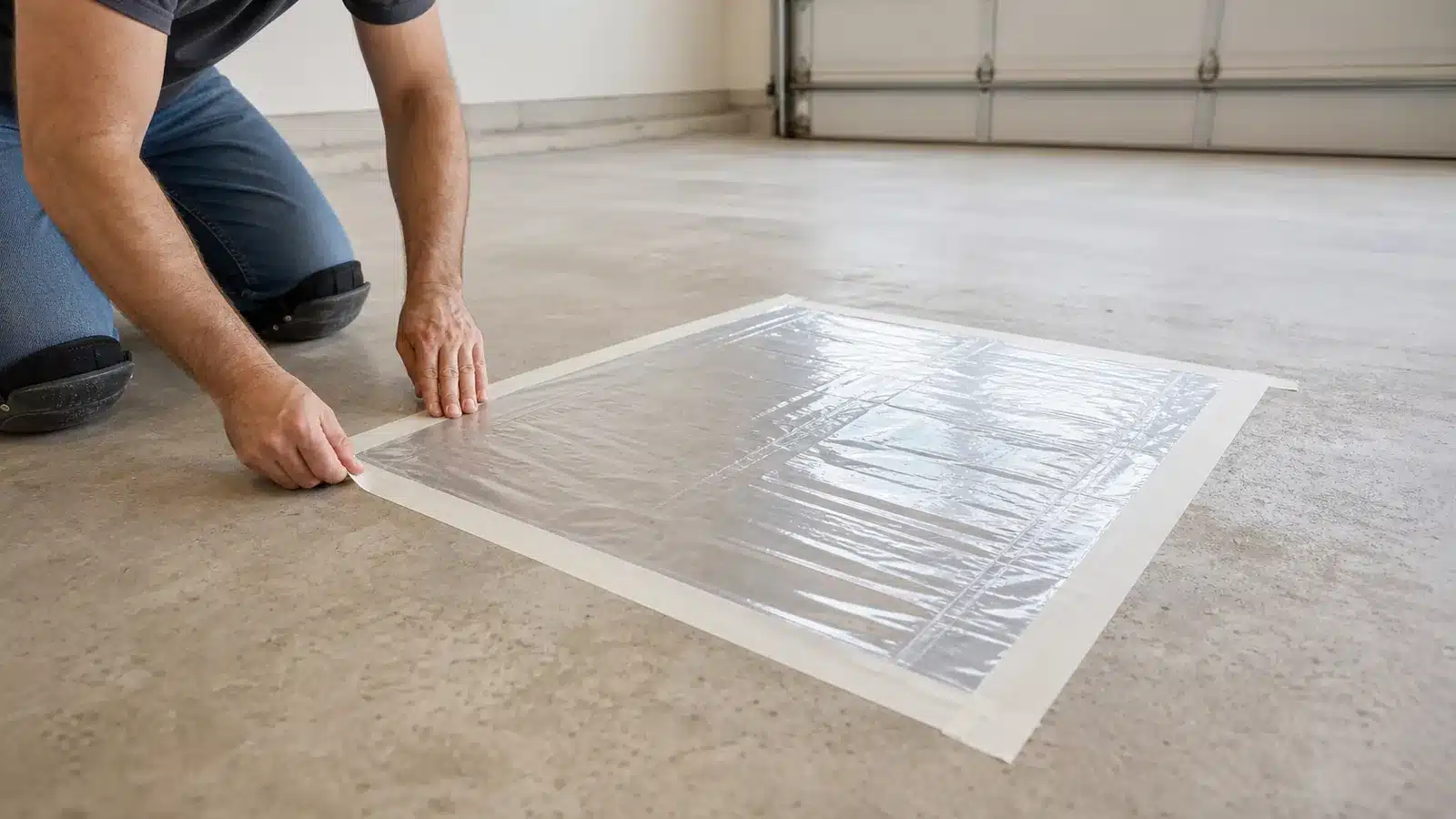
- Make a small mock-up: where appearance or adhesion is uncertain, test the approved combination in an inconspicuous area and let it reach the stated cure.
- Honor movement joints: use the coating system’s detail instead of burying the joint under a rigid film.
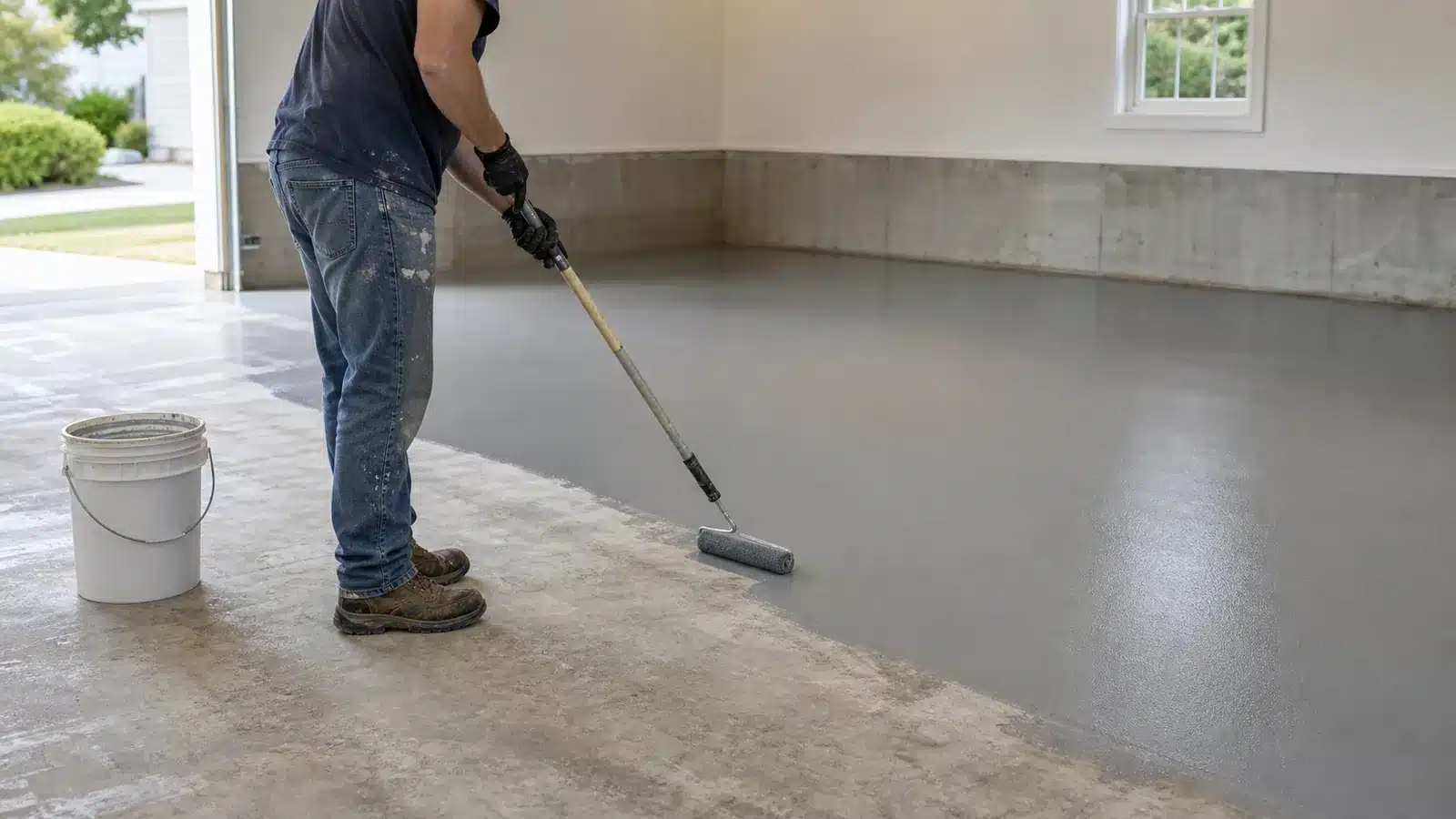
For the broader finish decision, compare the pros and cons of sealing or coating a garage floor. Repair is only one part of substrate preparation; contamination, surface profile, moisture, temperature and the existing finish also determine adhesion.
Preparation steps that apply to most garage-floor repairs
Identify and document the defect
Measure width, check level, photograph the full path and note when it becomes wet or changes. Decide whether it is a crack, intentional joint, pit, spall or combination.
Read the exact label and data sheet
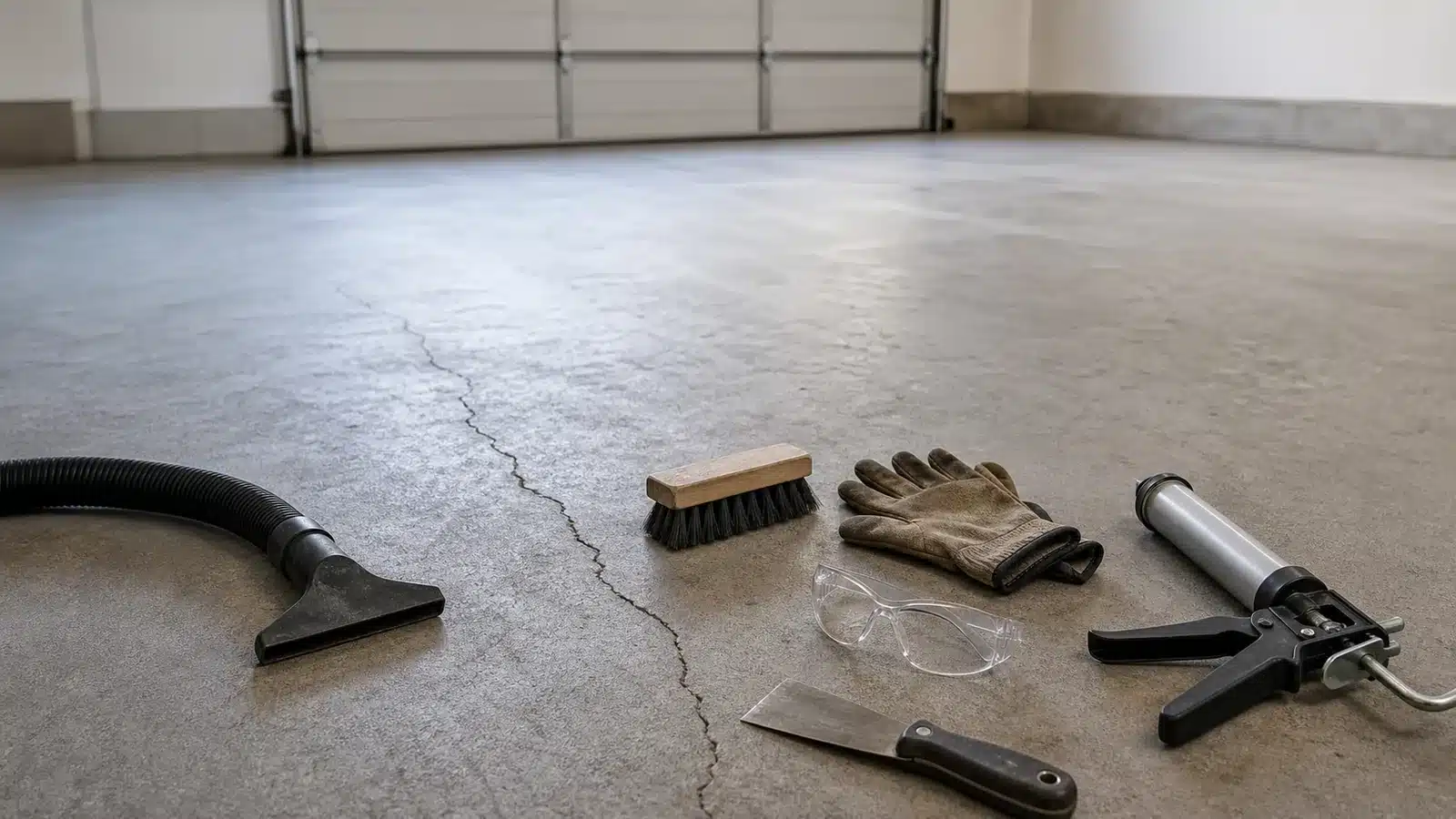
Confirm substrate, orientation, width, depth, backing, temperature, ventilation, protective equipment, cure, traffic and overcoating. Do this before opening the package.
Remove only unsound and contaminating material
Vacuum dust and loose particles. Clean oil, grease, old sealant and residue with a method the product permits. The sides must be sound enough for adhesion.
Keep the joint geometry intentional
Use backer rod or bond-breaker material where directed. Correct geometry limits waste and helps flexible sealant stretch across the opening instead of bonding to every surface.
Apply within the stated conditions
Check slab and air temperature, dryness, slope and working time. Mix multi-part products in the stated ratio and do not thin or extend them unless the manufacturer permits it.
Protect the repair through full return to service
Keep dust, water, tires, jacks and foot traffic away for the required period. Cooler or more humid conditions can lengthen cure for some products.
Backer rod, bond breakers and why depth matters
A deep crack does not need to become a solid column of flexible sealant unless the manufacturer specifies that geometry. Closed-cell backer rod can support the bead, control depth and reduce material use. A bond breaker helps prevent three-sided adhesion, allowing a joint sealant to stretch between opposing faces instead of being restrained along its bottom.
Sika’s Crack Flex data calls for closed-cell backer rod or bond-breaker tape in horizontal joints and describes a 2:1 width-to-depth design, subject to its stated minimums and maximums. Sashco also advises backer rod or sand for a deep crack. Those instructions are product-specific examples, not permission to improvise dimensions for another sealant.
Cure time is not one number
A product can form a skin before it is ready for tires, grinding, immersion or a coating. Rust-Oleum says 301012 can be painted in eight hours under its instructions. Sika lists one to two hours tack-free and three to five days for final cure for Crack Flex. Sashco notes that drying can take longer in high humidity or low temperatures.
Plan around the slowest relevant milestone. If a vehicle must return to the garage, use the exact traffic guidance rather than a general dry-to-touch time. If the repair will be coated, follow both the minimum cure and any maximum recoat window named by the complete system.
Frequently asked questions
What is the best garage floor crack filler?
For a sound, static crack before a compatible coating, a rigid product such as Rust-Oleum 301012 may fit. For a level horizontal crack that needs flexibility, Sikaflex+ Crack Flex is the more relevant category. For an irregular opening that needs tooling, Sashco Slab is a useful alternative. Diagnose movement and moisture first.
Should I use epoxy or polyurethane in a garage-floor crack?
Use epoxy when the exact repair is sound, non-moving and compatible with the finish. Use a polyurethane crack or joint sealant when its manufacturer identifies the horizontal application and movement. A chemistry name alone does not settle joint design, cure or coating compatibility.
Can crack filler stop water from coming through a garage floor?
It may seal the visible opening within its rated use, but it does not correct the water source or guarantee that moisture will not appear elsewhere. Diagnose drainage, grading, plumbing and vapor conditions before coating or concealing the symptom.
Will the crack come back through epoxy?
It can. A floor coating does not stop slab movement. A moving crack, joint or poorly bonded repair can reflect through or break the coating. Use the coating manufacturer’s crack-and-joint detail and address structural or moisture causes first.
How we verified this guide
- Rust-Oleum Concrete Patch & Repair 301012 for identified uses, two-part epoxy construction and paint timing.
- SIKA Sikaflex+ Crack Flex product page for horizontal crack use, movement, temperature, cure and preparation.
- SIKA Sikaflex+ Crack Flex product data sheet for joint dimensions, backing, slope, moisture-vapor and overcoating limits.
- Sashco Slab 16210 for garage/joint uses, flexible behavior, non-self-leveling application, backing and exclusions.
- Loctite PL Self-Leveling Concrete 1618150 for contraction/expansion-joint, crack, traffic and garage-floor use.
- QUIKRETE crack-repair guidance for cleaning, crack preparation, backing and the differences among pourable, toolable and self-leveling products.